Are Japanese people religious? The answer is not a simple yes or no. Many people who do not identify with a particular faith still visit shrines at New Year, attend Buddhist memorial services, pray for success, or maintain family rituals. Yet these practices do not necessarily express the same beliefs—or even feel explicitly religious—to everyone who participates.
The apparent contradiction becomes clearer when religious identity, personal belief, institutional affiliation, and customary practice are considered separately. From a Japanese everyday perspective, it can be more revealing to ask where religion remains present in life than to classify everyone as either religious or non-religious. This article explains how religious traditions can carry spiritual, familial, seasonal, and communal meanings at the same time.
The Short Answer: Some Are, Some Are Not, and the Categories Often Overlap
There is no simple yes-or-no answer. Japan includes committed believers, members of religious organizations, people who describe themselves as non-religious, and people whose identity is mixed, uncertain, or not especially important to them.
The confusion often comes from treating religious identity and religious practice as the same thing. Someone may visit a Shinto shrine at New Year, receive a protective charm, attend a Buddhist memorial service, or visit a family grave without identifying as Shinto or Buddhist. At the same time, another person may perform the same act with a strong sense of faith or spiritual commitment.
An outwardly religious act therefore does not tell us everything about the participant. To understand the apparent contradiction, it helps to separate several questions:
- Does the person identify with a religion?
- What do they personally believe?
- Do they belong to or support a religious institution?
- Which customs and family rites do they participate in?
The answers do not always match neatly. From my perspective, asking where religious traditions remain present in a person’s life is often more revealing than forcing everyone into either a “religious” or “non-religious” category. This does not mean that such customs are empty of religious meaning—only that their meaning varies from person to person.
Religious Identity and Everyday Practice Answer Different Questions
“What religion do you belong to?” may refer to several related but distinct matters: how someone identifies, whether they formally belong to a religious organization, or which tradition they consider their own. “What customs do you observe?” asks about practice. The answers may be connected, but they do not necessarily match.
Someone may have no strong religious identity or institutional affiliation yet continue customs associated with family, community, major life events, or the annual calendar. Such participation can carry several meanings at once: spiritual significance, respect for relatives, social obligation, seasonal celebration, or simple familiarity.
Participation in a religiously rooted practice also does not automatically show that someone accepts a particular doctrine or considers that tradition central to their identity. The meaning depends on the person and the context. Participation is evidence that a tradition is present in someone’s life—not definitive proof of what they believe, how they identify, or whether they belong to an institution.
From my perspective, this is why descriptions such as “Japan is Shinto” or “Japan is Buddhist” can feel disconnected from everyday reality. They give Japan one religious label when the more useful question is often where particular traditions appear: in family responsibilities, community relationships, seasonal observances, or important transitions.
Answers about identity or affiliation can still be informative, but each captures only one dimension. To understand religion in Japanese life, it helps to examine self-identification, personal belief, institutional ties, and customary practice separately rather than expecting one answer to explain them all.
Where Religious Traditions Appear in Daily and Family Life
Religious traditions are especially visible in seasonal observances, family responsibilities, and major life events. Around New Year, many people make a first visit of the year—hatsumode—to a shrine or temple. Visitors may offer a prayer, draw a fortune, or obtain an omamori charm associated with wishes such as good health, safe travel, academic success, or protection from misfortune.
Family practices may include visiting graves, attending Buddhist memorial services for deceased relatives, or maintaining a Buddhist altar (butsudan) or Shinto household shrine (kamidana). Whether and how these observances are maintained varies considerably by household, region, and family history.
Major transitions can also bring people into contact with religious institutions. A family may visit a shrine after a child’s birth or for Shichi-Go-San, an observance for young children. Someone preparing for entrance exams may pray for success or carry a charm, while illness may prompt prayers for recovery. Weddings and funerals may involve different traditions according to family preferences, established institutional relationships, and practical considerations.
These are established examples of religiously connected practices, but participation does not have one fixed meaning. The same observance may represent devotion for one person, family responsibility or seasonal custom for another, or several of these meanings at once.
Why a Religious-Looking Act May Not Feel Like a Declaration of Faith
From my perspective, visiting a shrine or taking part in a New Year observance is not always accompanied by the strong thought, “I am performing a religious act.” The practice may instead feel like welcoming the new year, showing respect, spending time with family, or continuing something familiar.
Repetition helps create this sense of familiarity. When an observance is woven into the annual calendar or passed down through a family or community, people may experience it primarily as seasonal, respectful, or customary. Its religious background remains relevant, but it may not be the only—or most immediate—meaning for every participant.
That does not make the act automatically secular or spiritually empty. One person may pray with sincere faith, another may value the same practice as a family tradition, and someone else may combine devotion, hope, social convention, and cultural familiarity. Even the participant may not separate these motives neatly.
It is therefore useful to distinguish three things: a practice’s religious origin, its present-day role in family or community life, and the individual participant’s beliefs. These can overlap without being identical. Looking at where religious traditions remain present in life captures this complexity better than assuming that every religious-looking action is a public declaration of faith—or that customs have lost all religious significance when participants do not describe themselves as religious.
Using More Than One Tradition Does Not Always Require One Exclusive Identity
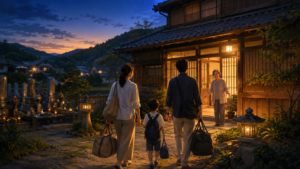
The traditions present in a person’s life may vary by occasion. A family might visit a Shinto shrine for a child’s shichi-go-san celebration, maintain a relationship with a Buddhist temple for ancestral memorial services, and choose a wedding ceremony in a different style. These choices do not necessarily form a single, carefully defined religious identity.
Which institution a family turns to may reflect family history, local relationships, or established custom. Funeral and memorial arrangements, for example, may be connected to a temple that has served the family for generations. A nearby shrine may be the familiar place to visit at New Year or to pray for success in an exam. Practical factors can matter alongside spiritual beliefs.
From my perspective, this is one reason descriptions such as “Japan is Shinto” or “Japan is Buddhist” can feel disconnected from everyday reality. Looking at where each tradition appears—in family rites, community relationships, or particular stages of life—is often more informative than trying to assign one exclusive label to the person or to Japan as a whole.
However, this pattern should not become another generalization. Not every household draws on multiple traditions, and not everyone is comfortable doing so. Some people maintain a clear commitment to one faith or religious organization, while others deliberately avoid certain institutions or practices. The coexistence of different traditions is one possible pattern in Japanese life, not a rule that applies to everyone.
There Is No Single Japanese Distance from Religion
Relationships with religion vary widely across Japan. Family history, region, generation, community ties, and personal experience can all shape whether religion feels central, occasional, uncomfortable, or largely irrelevant to someone’s life. Even members of the same household may understand a shared observance differently.
For some people, prayers, memorial rites, or teachings have deep spiritual importance. Others participate mainly to respect relatives, meet family expectations, or maintain a community tradition. Some belong actively to religious organizations and arrange significant parts of their lives around their faith. Others deliberately avoid particular groups—or religious practices more broadly—because of their beliefs, experiences, or concerns about organized religion.
A person’s position can also change according to circumstances. Religion may seem distant in ordinary life but become more significant during bereavement, illness, or another major transition. Conversely, someone may maintain a family rite while feeling little connection to the institution responsible for it.
From my perspective, looking at where religious traditions remain present is often more useful than forcing everyone into “religious” and “non-religious” categories. But this is an interpretive framework, not a universal Japanese attitude. It describes one common way of making sense of everyday practices while leaving room for committed believers, firm nonbelievers, uncertain or mixed positions, and people whose relationship with religion does not fit any simple label.
A Better Question: Where Does Religion Remain Present?
Rather than placing each person in a religious or non-religious category, it is often more useful to examine several dimensions separately:
- Self-identification: Does the person describe themselves as religious, non-religious, uncertain, or something else?
- Personal belief: Do they believe in particular deities, teachings, spiritual forces, or ideas about death and ancestors?
- Institutional ties: Do they belong to, support, or regularly visit a religious organization?
- Family rites: What practices are maintained for ancestors, memorials, or household traditions?
- Seasonal customs: Which religiously rooted observances remain part of the annual calendar?
- Major life events: Which institutions or rituals become relevant during birth, marriage, illness, death, examinations, or other transitions?
These questions may produce different answers for the same person. Someone might reject a formal religious label while valuing a family memorial service. Another person might visit a shrine as an expression of sincere faith, while someone beside them sees the same visit mainly as a New Year custom.
The appearance of an act therefore tells us only part of the story. A better next question is: What does this practice mean to this particular participant? Its meaning may be devotional, familial, seasonal, communal, or practical—and several of those meanings can coexist.
From my perspective, asking where religion remains present in life comes closer to everyday reality than forcing everyone into a religious or non-religious box. This approach shows how religious traditions can remain visible even when religion is not the main identity a person uses to describe themselves.
The most accurate answer to “Are Japanese people religious?” consequently depends on what religious means in the question. If it means formal affiliation, the answer may be one thing; if it refers to belief, family obligations, seasonal practices, or choices at major life events, it may be another.
Conclusion
Japanese people cannot be described accurately as simply religious or non-religious. Formal identity, personal belief, institutional affiliation, and participation in religiously rooted customs are separate dimensions, and they do not always align.
A shrine visit, Buddhist memorial service, family grave visit, or seasonal observance may express sincere faith, family responsibility, social convention, cultural familiarity, or several meanings at once. Its outward form alone cannot reveal what a participant believes. At the same time, a lack of formal affiliation does not mean religious traditions are absent from that person’s life.
The most useful approach is therefore to ask where religion appears and what it means in each context. Family, region, generation, community, and personal experience all shape the answer. This framework leaves room for committed believers, deliberate nonbelievers, and people whose practices and identities do not fit neatly into either category—and offers a clearer view of religion’s varied place in everyday Japanese life.




Comments