If textbooks teach that “goodbye” is さようなら (sayōnara), why do Japanese speakers rarely use it with friends, family, or coworkers? The word is correct and widely understood, but in everyday conversation it can sound more formal, distant, or final than learners expect. Japanese farewells are usually chosen according to the relationship, setting, and likelihood of meeting again.
This article explains when sayōnara sounds natural, why it has a strong association with school greetings, and what people commonly say instead—from じゃあね (ja ne) and またね (mata ne) among friends to お疲れさまでした (otsukaresama deshita) and 失礼します (shitsurei shimasu) at work.
Do Japanese People Actually Say Sayonara?
Yes. さようなら (sayōnara) is a real, widely understood Japanese word for “goodbye.” However, it is much less common in casual daily conversation than many beginner textbooks suggest.
In my experience, Japanese speakers rarely use sayōnara when parting from close friends or family members. It is not incorrect, but it may sound more formal or distant than the situation requires. Other expressions are usually more natural when the relationship is familiar and another meeting is expected.
Whether sayōnara fits depends mainly on three things: your relationship with the other person, the setting, and how soon you expect to meet again. A farewell that works in a structured or formal situation may feel out of place after coffee with a friend. In Japanese, choosing a farewell is therefore less about finding a direct translation of “goodbye” and more about matching the social context.
Sayonara in Hiragana: さようなら or さよなら?
Both さようなら and さよなら are correct Japanese spellings of sayonara. The longer さようなら is the standard full form, while さよなら is a common shortened form used in modern Japanese.
Their basic meaning is the same. However, さようなら may look or sound slightly more formal and careful, while さよなら can feel a little more conversational. In everyday use, the difference is usually less important than the situation and the relationship between the speakers.
The spelling also explains why you may see both sayōnara and sayonara in English. Sayōnara represents the long “o” sound in さようなら more precisely, while sayonara is the familiar English spelling.
Sayonara is normally written in hiragana. There is no standard kanji spelling that learners need to use:
- Full form: さようなら
- Shortened form: さよなら
- Common English spelling: sayonara
- More precise romanization: sayōnara
Whichever spelling is used, the expression does not automatically mean “goodbye forever.” Its emotional weight depends mainly on the context, tone, and relationship.
Why Sayonara Can Feel More Final Than “Goodbye”
The dictionary meaning of さようなら (sayōnara) is “goodbye,” but the two words do not always create the same impression. In many everyday situations, sayōnara can sound more formal, distant, or ceremonious than its English equivalent.
It may also suggest that some time will pass before the speakers meet again. From my perspective, hearing sayōnara can create a slight sense of separation, even when no one intends it as a dramatic farewell. That is why saying it after a casual lunch with a friend—especially when you expect to meet again soon—may feel unnecessarily weighty.
However, sayōnara does not inherently mean “goodbye forever.” Its force depends on the relationship, situation, and delivery. A cheerful sayōnara in a structured setting can sound perfectly ordinary, while the same word said slowly or coldly may communicate seriousness or emotional distance.
The important distinction is therefore between dictionary correctness and social naturalness. Sayōnara may be grammatically correct, yet still feel mismatched if the parting is casual and routine.
Sayonara vs. Ja Ne and Mata Ne
Among friends and family members who expect to meet again, casual expressions usually sound more natural than さようなら (sayonara).
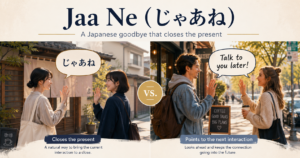
じゃあね (ja ne) is a relaxed way to end an interaction. It is similar to “see you” or “bye, then,” with じゃあ signaling that it is time to go and ね giving the phrase a friendly tone.
じゃあね、気をつけて。
Ja ne, ki o tsukete.
“See you—take care.”
またね (mata ne) literally points toward “again,” so it emphasizes meeting another time. It often feels warm and reassuring, even when no specific plan has been made.
またね!
Mata ne!
“See you again!”
Friends also combine the two:
じゃあ、また。
Jaa, mata.
“Well, see you.”
If the next meeting is known, Japanese speakers often mention it directly:
- また明日 (mata ashita) — “See you tomorrow.”
- また来週 (mata raishū) — “See you next week.”
- じゃあ、金曜日に (jaa, kin’yōbi ni) — “See you on Friday, then.”
These are not simply interchangeable translations of the English word “goodbye.” Their function is to recognize an ongoing relationship and an expected next meeting. From a Japanese perspective, that is why じゃあね or またね generally feels more natural than さようなら after an ordinary visit, meal, or conversation with someone close.
Why Workplace Goodbyes Use Different Expressions
At work, Japanese farewells often reflect the speaker’s role and workplace etiquette rather than simply translate “goodbye.” The person leaving before others commonly says:
お先に失礼します (osaki ni shitsurei shimasu)
“Excuse me for leaving before you.”
Coworkers may respond:
お疲れさまでした (otsukaresama deshita)
“Thank you for your work.”
These expressions perform different social functions. お先に失礼します politely acknowledges that others are still working, while お疲れさまでした recognizes the other person’s effort. The latter is also commonly used when the workday or a shared task has ended.
The shorter 失礼します (shitsurei shimasu) signals that the speaker is leaving or excusing themselves, such as when departing from an office or meeting. The appropriate wording varies according to hierarchy, timing, and workplace culture, and more relaxed workplaces may use less formal versions.
By contrast, さようなら (sayōnara) can sound detached or out of place when leaving work because it does not acknowledge either the shared effort or the act of departing before others. In a workplace, the natural expression depends on what the speaker is doing socially: announcing their departure, recognizing completed work, or responding to the person leaving.
The Strong School Association of Sayonara
One context in which さようなら (sayōnara) remains familiar is the classroom. Many Japanese people associate it with a set greeting exchanged between teachers and students at the end of the school day:
Teacher: さようなら。
Student: さようなら。
Because this exchange is part of an organized classroom routine, repeated over many school years, sayōnara can carry an orderly and somewhat formal tone. From a Japanese perspective, its association with teachers and students is often stronger than its association with casual farewells between close friends.
School customs do vary by school, teacher, age group, and region. Some classes may use a different closing greeting, so this is a strong cultural association rather than a rule followed in every classroom.
This context also shows why frequency depends on the situation. A student might naturally say さようなら to a teacher as part of the class closing ritual, then use a much more casual expression when parting from friends outside the school gate. The word can therefore be common within a specific social routine while remaining relatively uncommon in relaxed conversation among people who are close.
When Sayonara Can Sound Natural
さようなら (sayonara) can be appropriate when the parting itself carries some formality or weight. Examples include a structured teacher-student greeting, a formal farewell, or saying goodbye to someone you may not see for a considerable time.
It can also be a deliberate choice. A speaker might use sayonara to create emotional distance, express seriousness, or give a relationship or period of life a sense of closure. In these cases, its heavier tone is part of the message rather than an accidental effect.
There is no fixed rule that sayonara becomes natural only when people will be apart for a certain number of weeks or years. Tone, relationship, and intention matter more than the length of the separation. Even when someone is moving far away, a speaker might choose a lighter farewell to emphasize that the relationship will continue.
Individual speaking style matters too. Some people use sayonara more readily than others, and customs vary between communities and institutions. Learners therefore do not need to avoid the word—they simply need to choose it when a more formal, serious, or meaningful farewell fits the situation.
How to Choose a Natural Japanese Farewell
Rather than searching for one Japanese equivalent of “goodbye,” choose an expression based on the relationship, setting, and type of parting.
| Situation | Natural choice | Social function |
|---|---|---|
| Leaving friends or family when you expect to meet again | じゃあね (jā ne) or またね (mata ne) | Casually ends the conversation or looks ahead to the next meeting |
| Leaving work | お疲れさまでした (otsukaresama deshita) | Acknowledges everyone’s work and effort |
| Politely leaving an office, meeting, or other formal space | 失礼します (shitsurei shimasu) | Signals that you are excusing yourself |
| A set teacher-student greeting | さようなら (sayōnara) | Fits an established, orderly school routine |
| A formal or emotionally weighty separation | さようなら (sayōnara) | Can add seriousness, distance, or a sense of closure |
When unsure, ask yourself three questions:
- How close are we? Close friends and family generally call for casual language.
- What setting are we in? A workplace or classroom may have its own conventional greeting.
- Is this a routine parting or a meaningful separation? If it is simply the end of an ordinary visit, a lighter expression will often fit better.
The important point is that these phrases are not mechanically interchangeable translations of “goodbye.” またね maintains a sense of connection, お疲れさまでした recognizes shared work, and 失礼します politely marks your departure. Learn each expression together with the situation in which it is used, and your farewells will sound much more natural.
How Do You Reply to Sayonara?
If someone says さようなら (sayōnara) to you, it is usually natural to reply with the same expression:
Teacher: さようなら。
Student: さようなら。
In a formal farewell or a school setting, simply repeating さようなら is polite and appropriate. You do not need to create a special response.
In a more casual situation, your reply can match the relationship and the expected next meeting. For example, you might respond with またね (mata ne), meaning “see you again,” or じゃあね (ja ne), meaning something like “see you” or “bye, then.”
However, if the other person deliberately uses sayonara to make the farewell sound serious or final, replying with a very casual じゃあね may feel mismatched. The safest approach is to match the other person’s tone: use さようなら for a formal or weighty farewell, and a lighter expression when the parting is clearly casual.
Conclusion
さようなら (sayōnara) is correct Japanese, but it is not the all-purpose everyday “goodbye” that textbooks sometimes make it seem. In casual relationships, it may feel more formal, distant, or final than intended—though it does not automatically mean “goodbye forever.”
A natural farewell depends on what the parting communicates socially. With friends and family, じゃあね (jā ne) or またね (mata ne) usually reflects an ongoing relationship. At work, お疲れさまでした (otsukaresama deshita) acknowledges shared effort, while 失礼します (shitsurei shimasu) politely marks your departure. さようなら remains appropriate in certain structured school greetings and in farewells meant to carry greater formality, seriousness, or emotional weight.
The most useful habit is to learn Japanese farewells as situation-based expressions, not direct translations. Consider your relationship, the setting, and whether the separation feels routine or meaningful. That will guide you toward a farewell that sounds natural and conveys the right tone.






Comments